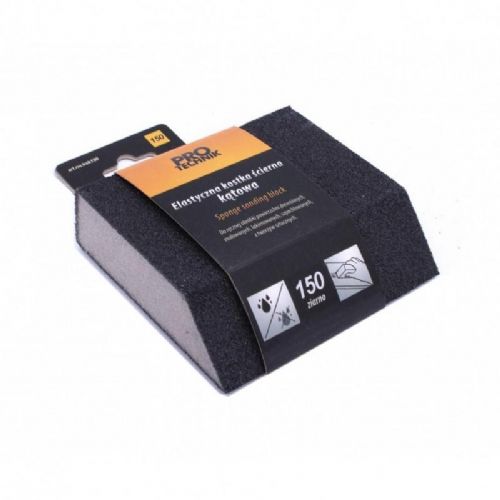
Protechnik P60 angle sanding sponge - precise sanding of hard-to-reach places
Suitable for hand detail sanding Good for corners, edges and profiles For rough material removal
The P60 sanding sponge is an excellent choice for consumers who want to effectively sand edges, corners or uneven surfaces on a variety of materials.
- Flexible design for easy use in corners and curves
- Grit size P60 for rough paint or rust removal
- Manual use allows precise control over sanding
- Suitable for wood, metal or plastic
P60 Corner Sanding Pad 70x100x25mm - Premium sanding block for perfect edges and hard-to-reach places
Are you looking for an effective solution for sanding difficult corners, grooves and edges? The P60 angle sanding pad (dimensions 70x100x25mm) is an indispensable tool for both professional craftsmen and DIY enthusiasts. This high-quality sanding block is specially designed for precise surface treatment where conventional sandpaper fails. With the P60 grit, you can quickly and effortlessly remove stubborn layers of old paint, varnish, rust or simply smooth out rough wooden and plaster surfaces.
Thanks to its innovative beveled shape and four-sided abrasive coating made of durable silicon carbide, this sanding sponge provides exceptional grip and even pressure. Forget about uneven edges and material damage - with our angle sanding sponge you will achieve professional results on every project.
---
Why choose P60 angle sanding sponge? Main advantages
When preparing surfaces for further processing, such as painting or varnishing, choosing the right tool is crucial. Here are the main reasons why this sanding block is the first choice for demanding jobs:
Special shape for corners and grooves: The cut side of the sponge is specially designed to make it easier to access tight, narrow and hard-to-reach places. It will help you easily reach sharp corners without damaging adjacent surfaces.
Four-sided abrasive coating: The sponge is fully coated (on all four sides) with high-quality abrasive material, which extends its lifespan and allows maximum use of every millimeter of the tool.
Flexible and soft core: The flexible foam interior ensures that the sponge adapts perfectly to the shape of the workpiece. This distributes pressure evenly, preventing deep scratches.
Premium material (Silicon Carbide): Extremely hard and sharp abrasive material ensures fast material removal and long durability even when grinding harder surfaces.
Versatile use: Ideal for dry or wet sanding of various materials such as wood, metal, plastic, putty, plasterboard and painted surfaces.
---
Technical specifications and product features
To ensure your work runs smoothly and without interruptions, the KSK60 sanding sponge boasts the following technical features:
Product code (SKU): KSK60
Dimensions: 100mm x 70mm x 25mm
Grit: P60 (coarse gradation for fast material removal and leveling)
Abrasive material: High quality silicon carbide
Design: Four-sided coated sponge with beveled edge for corners
Category: Sandpapers and sponges
Price: 4.99 EUR
---
Versatility of use: From furniture restoration to drywall work
This sanding block is extremely versatile and indispensable for a variety of renovation and construction projects. Whether you're in the middle of renovating your apartment or creating a unique wooden product, the P60 sanding pad will make the following tasks easier:
Wooden furniture restoration: Quickly removes old layers of varnish, paint or wax from wooden chairs, tables and cabinets, especially at joints and decorative grooves.
Smoothing wall corners (gypsum boards): Works great for sanding plasterboard joints (Knauf) in the corners of rooms where conventional sanders cannot reach the surface.
Metal surface preparation: Removing surface rust and preparing metal profiles or railings before applying primer.
Matting of painted elements: Creating the ideal texture for adhesion of new paint on already painted surfaces.
Tip for safe and efficient work: Fine particles and dust are released during sanding. To protect your health, we highly recommend using a respirator and safety glasses. After finishing work, simply blow out or rinse the sponge with water to remove accumulated dust and extend its lifespan.
---
Frequently Asked Questions (FAQ)
1. For which materials is the P60 angle sanding sponge suitable?
The sanding sponge is extremely versatile and can be used on a wide range of materials. It works great for sanding soft and hard wood, metal, plastic, varnished and painted surfaces, and gypsum plasters (putty and plasterboard).
2. What is the advantage of P60 granulation?
P60 grit is a coarse grit. This means that it is intended for rapid removal of large amounts of material, removal of old coatings, rust, and rough shaping of surfaces before fine sanding with higher grits.
3. Can this sanding sponge be used for wet sanding?
Yes, thanks to the flexible foam core and silicon carbide abrasive, the sponge is suitable for both dry and wet sanding, which reduces dust and prevents the sanding surface from filling up quickly.
Responsible persons:
PROTECHNIK - iRMA Tomasz Matoga Spółka Komandytowa, ul. Królewska 69, 32-447 Siepraw, Poland, biuro@irma.pl (+48) 122728810
Distributor for Slovenia: Haloorodje.si, Online Sales, Rok Groznik sp, Podturn 42, 8350 Dolenjske Toplice, info@haloorodje.si, +38669731944, Slovenia
Product origin: China
Instructions for using the product:
• Before using, check whether the P80 angle sanding sponge is suitable for your task and the material you want to process.
• Before starting sanding, check that all safety precautions are followed, such as wearing safety glasses, gloves and masks.
• Start by working the surface. Make sure to hold the sponge at the correct angle and move it evenly across the surface.
• If necessary, adjust the speed and pressure on the sponge to achieve the desired result.
• Check the condition of the sponge regularly while sanding. If it is worn or damaged, replace it with a new one.
Useful tips for work:
• Before starting sanding, check that the surface you want to treat is clean and free of major irregularities.
• For better results, we recommend using the sanding sponge in combination with other grits, depending on the level of processing.
• Be careful not to apply too much pressure when sanding, as this may cause uneven sanding or damage to the surface.
• Regularly check the condition of the sponge during operation and replace it if necessary to ensure optimal performance.
• After finishing work, clean the sanding sponge and store it in a dry place, away from moisture and direct sunlight.
Warnings:
• Do not press too hard to avoid damaging the surface.
• Wear safety glasses and a mask when sanding.
• Clean the sponge after use and store it in a dry place.
Same summary
The P60 angle sanding sponge is particularly suitable for hand sanding hard-to-reach areas such as inside corners, edges or profiles, where conventional sandpapers are often not flexible enough. Its coarse P60 grain allows for effective removal of old paint, rust or larger irregularities, but is not optimal for very fine surface finishing. If you need control over sanding on uneven or rounded surfaces and want to prevent excessive material wear, this sponge is a sensible choice. It may prove to be less optimal for larger flat surfaces or for extremely fine finishing work - in these cases it is recommended to use a more suitable accessory or a different grain.
Recommendation source: Enaa guides and team experiences.
User view
DIY enthusiasts, craftsmen and anyone who frequently renovates or maintains furniture will most often use the P60 Corner Sanding Pad for thorough preparation of surfaces before painting or protective coating. The flexible structure of the pad allows for good contact even with hard-to-reach corners or edges, making it particularly suitable for processing window frames, doors or furniture elements where standard tools fail. Due to the more intensive material removal, it is used mainly in the initial stages of processing, so its main purpose is rough preparation, and at the end you can finish the work with fine sandpaper.
Users also appreciate the consistent quality of Protechnik brand tools, which are characterized by good durability and reliability in everyday use.
Why buy at Enaa
It offers the option to choose from a proven range of tools from various manufacturers, convenient search using important filters and detailed categorization, making it easier and faster to find the right grinding tool for individual projects.
Answers to frequently asked questions
For which materials is the P60 angle sanding sponge suitable?
The P60 angle sanding sponge is suitable for initial processing of wood, metal and some types of plastic, allowing for the effective removal of old paint, rust and larger irregularities in hard-to-reach places.
What does the P60 marking on a sanding sponge mean?
The P60 designation indicates coarse granulation, which means that the sponge is intended for coarser sanding and greater material removal - this is useful in the first stages of renovation or surface preparation.
Is the sanding sponge suitable for use with power tools?
This type of sponge is usually intended for manual use, as its flexible structure allows for better feel and control in corners or on shaped surfaces, while for machine sanding we recommend using special attachments or strips.
How to prevent premature wear of the sanding sponge?
To prolong the life of the sponge, avoid excessive pressure while sanding and clean it regularly by gently blowing off the dust. It is also recommended to use several different grits in sequence for a better final result.
Description updated: April 2026