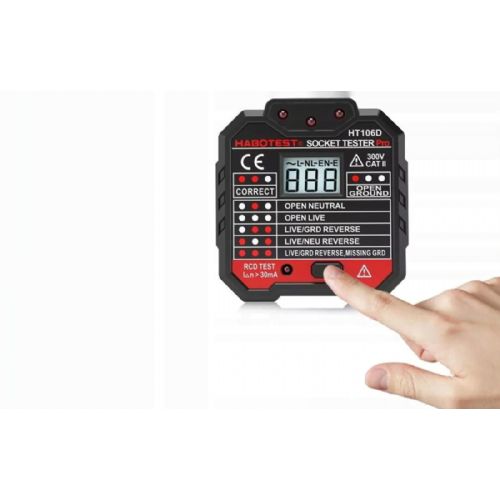
Habotest Digital socket tester with LCD – quick and clear checks
Suitable for home use Handheld, portable model Measurement up to 300 V
The digital tester is designed for consumers to easily and safely check the voltage and condition of electrical outlets at home or in the field.
- Clear LCD display shows results instantly
- Easy to use without complicated settings
- Suitable for quick troubleshooting of installations
- Compact and lightweight for use anywhere
- Powerful enough for voltages up to 300 V
Digital socket tester with LCD HT106D – Quick and safe checking of electrical wiring
Home and office safety starts with a flawless electrical installation. The Digital Socket Tester with LCD (SKU: HT106D) is an extremely accurate, reliable and indispensable instrument for quickly testing electrical sockets. This small but extremely powerful device allows you to identify possible wiring faults, check the operation of the residual current device (RCD) and measure the mains voltage in seconds.
Thanks to its intuitive design and clear LCD display, the tester is suitable for both professional electricians and DIYers who want to ensure the safety of their loved ones and protect valuable electrical devices from damage.
Why choose the HT106D digital socket tester?
Incorrectly connected sockets, missing earthing or swapped phase and neutral conductors can cause serious damage to electrical appliances, and in the worst case even fire or electric shock. Using the HT106D tester you can elegantly avoid these dangers.
Key benefits for your safety:
Immediate fault diagnosis: LED indicators on the top of the device with light combinations immediately reveal the socket status (e.g. lack of grounding, lack of neutral cable or reversely connected cables).
Accurate voltage measurement: Voltage and frequency measurement results are displayed on a clear, high-resolution LCD screen.
Built-in RCD test: Simple test of the operation of the residual current device (RCD) with a single push of a button.
Backlight: The screen is equipped with a bright backlight, which allows for uninterrupted work and easy reading of data even in dark corners or poorly lit rooms.
Compact and durable: It is made of high-quality materials that ensure a long service life, while weighing only 50 grams, which means you can always carry it with you in your pocket or tool bag.
Technical specifications and features
The HT106D digital socket tester combines advanced technology and ease of use. The detailed technical specifications of the device are listed below:
Model / SKU
HT106D
Voltage range
AC 48-250V
Voltage measurement
Yes, 48-250V / 45-65Hz
RCD test (residual current circuit breaker test)
>30mA
LCD screen
Yes (with backlight)
Safety standards
EN61010-1, -2-030; EN61326-1, CAT II 300V
Weight
Approximately 50g
Dimensions
65 x 62 x 58 mm
How does the HT106D socket tester work?
Using the device is extremely simple and does not require any prior professional knowledge:
Connection: Simply insert the tester into the electrical outlet you want to test.
Voltage reading: On the illuminated LCD screen you will immediately see the current voltage (V) and frequency (Hz) of the electrical network.
Checking the wiring: The LED indicators on the top of the device will light up in a specific combination. There is a handy legend on the device housing that immediately tells you whether the wiring is correct or if there is a fault (e.g. missing ground, reversed phase/neutral, etc.).
RCD test: To test the residual current device, press the RCD test button. If the device is working properly, the current will be interrupted.
Frequently Asked Questions (FAQ)
What does the acronym RCD stand for and why is this test important?
RCD (Residual Current Device) is a residual current device (often called a residual current device). Its function is to turn off the electricity in milliseconds in the event of a current leak (e.g. when a person comes into contact with electrical voltage) and prevent fatal electric shock. The HT106D tester allows you to quickly check whether this switch in your home is working properly (triggered at a current >30mA).
Can the tester damage my electrical devices?
No. The tester is designed exclusively for measuring and diagnosing the condition of the socket and operates within a safe voltage range of AC 48-250V. It is manufactured in accordance with the strictest safety standards EN61010-1 and CAT II 300V, ensuring completely safe use.
Does the tester need batteries to operate?
No, the HT106D digital socket tester is powered directly from the electrical outlet you are testing. This means the device is always ready to use, without worrying about dead batteries.
Responsible persons:
HABOTEST - INNPRO Robert Błędowski Sp. z o. o., Rudzka 65c, 44-200 Rybnik, Poland, contact@innpro.eu, (+48) 696323914
Distributor for Slovenia: Haloorodje.si, Online Sales, Rok Groznik sp, Podturn 42, 8350 Dolenjske Toplice, info@haloorodje.si, +38669731944, Slovenia
Product origin: China
Instructions for using the product:
• Before use, check that the batteries in the tester are charged and installed correctly.
• Insert the tester into the socket you want to test.
• Check that the display is on and ready for testing.
• Run the test and check if the results are in line with your expectations.
• After use, turn off the tester and store it in a safe place.
Useful tips for work:
• Before use, check that the batteries in the tester are charged and installed correctly.
• Insert the tester into the outlet you want to test to ensure accurate measurements.
• When using the tester, be careful not to cause injury or damage to the instrument.
• After use, turn off the tester and store it in a safe place to avoid injury or damage to the instrument.
• Regularly check the condition of the tester and maintain it as necessary to ensure its long life and reliability.
• When using the tester, follow the manufacturer's instructions and avoid using it in unsuitable conditions.
Warnings:
• Connect the tester only to a suitable electrical network.
• Do not touch exposed metal parts during testing.
• Do not use a damaged tester.
• The tester does not replace a professional electrical inspection.
• In case of irregularities in the electrical installation, contact a qualified electrician.
Same summary
The digital socket tester with LCD is suitable for users who want to quickly and easily check electrical sockets and basic voltages at home or in the workshop. The digital version displays results clearly and accurately, which is especially useful for basic repairs and beginner electrical work. The device is handheld and portable, which allows for easy use in different locations, but the maximum measurement range of up to 300 V may limit its use for measurements above this threshold. For more advanced needs or specialized functions, it is worth considering models with a larger measurement range or additional features.
Recommendation source: Enaa guides and team experience.
User view
This tool is most often used by consumers who occasionally check the voltage at sockets or look for faults in electrical installations at home or in their car. It is very convenient for anyone who wants a quick insight into the status of their electrical installation without complicated settings or the need for experience in the field of electrical engineering.
Users often choose Habotest brand testers, as they are considered by experts to be a reliable and practical choice in the segment of simple digital measuring instruments.
Why buy at Enaa
In addition to a wide range and an up-to-date overview of available products in one place, Enaa also enables a systematic comparison of digital testers according to type, measurement range and other practical features. A team of experts ensures that the information is transparent and decision-making is easier for end users.
Answers to frequently asked questions
For which use cases is a digital socket tester with LCD best suited?
It works best for basic household electrical measurements or minor repairs where you need to quickly check the operation of sockets or the voltage at the connections.
Is it safe for beginners to use the tester?
The testers are designed for safe use, but basic precautions are always necessary when working with electricity. The digital display and clear markings increase safety even for less experienced users.
What does the measurement range up to 300 V mean?
This means that the tester can safely measure voltages up to 300 volts – this is enough for most home and automotive electrical installations. For measurements above this range, a more advanced device should be chosen.
Is the tester also suitable for working outside or in the garage?
The handheld and portable design allows for field use, but we recommend checking the moisture protection if you will be using the tester frequently outdoors or in humid areas.
How long does it take to read a measurement on the LCD screen?
The digital display displays the result almost instantly, making readings quick and easy for any user experience.
Description updated: April 2026